Now imagine doing all of that, receiving Turkish citizenship, and then finding out later that the government is reviewing the original transaction.
That is the part buyers should pay attention to.
In 2026, Turkish authorities publicly reported citizenship annulments and withdrawals, and a separate property-related investigation led to annulment proceedings involving hundreds of people. The lesson is not that every citizenship-by-investment purchase is unsafe. It is that a passport does not make a bad transaction disappear.
If citizenship is part of your property plan, the quality of the deal, the paperwork, the valuation, the payment trail and the people guiding you matter from the beginning.
What actually happened in 2026?
The headline numbers were significant.
Turkey’s Interior Ministry reported that investment-eligibility certificates for 1,150 investors were cancelled after irregular or sham transactions were identified. Including family members, citizenship decisions affecting 5,391 people were annulled. A separate category involved 263 investors identified after citizenship acquisition on public-order or national-security grounds; including family members, citizenship decisions affecting 743 people were withdrawn.
Together, the announcement referred to 1,413 investors plus family members: 5,391 + 743 = 6,134 people.
There is an important distinction: that does not mean 6,134 property buyers lost citizenship because of bad real estate deals. The Interior Ministry figures covered different categories, and the announcement did not present them as one property-only statistic.
Separately, Turkey’s Justice Ministry announced proceedings to annul citizenship involving 687 people in a property-related investigation. The allegations included false appraisals, low-value properties being presented at higher values, sham transactions and money movements that were not genuine.
Those were proceedings, not the same thing as saying every one of the 687 cases had already ended in a final cancellation.
Still, these were not hypothetical rules sitting in a statute book. The Interior Ministry reported thousands of people in categories where previously granted citizenship had been annulled or withdrawn.
For a buyer, the practical message is hard to ignore: transactions can be reviewed later, and problems in the original file can matter long after the property has been purchased.

Annulment vs withdrawal — in plain English
You do not need to become a Turkish citizenship lawyer to understand the basic idea.
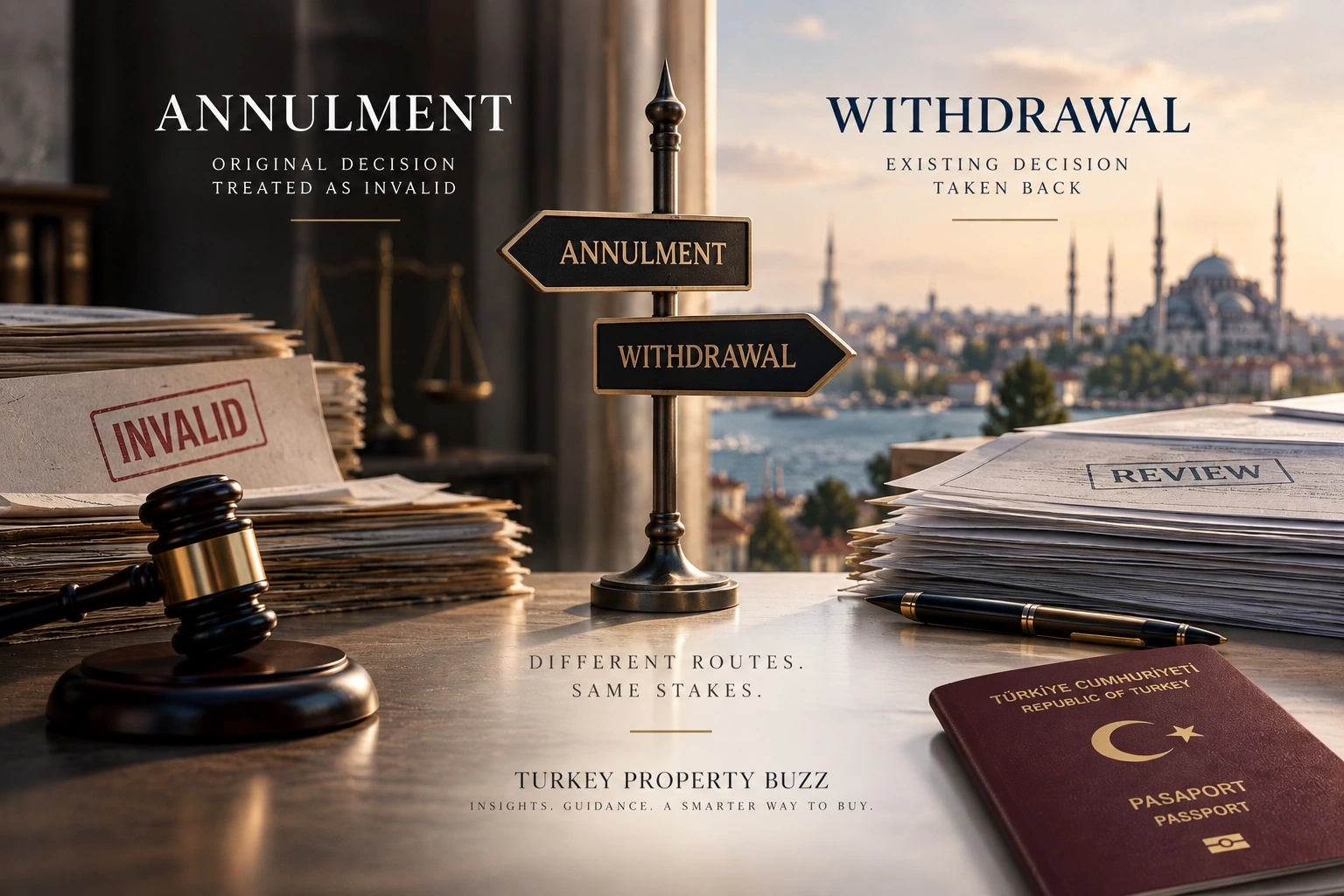
Annulment is one legal route for undoing a citizenship decision where the original grant was based on something materially false, hidden or otherwise defective.
Withdrawal is a different legal route that can apply where the legal basis for the citizenship decision was not properly satisfied or in certain other circumstances.
The exact legal distinction matters to a person facing a real case. For a buyer researching Turkish citizenship by investment, the simpler takeaway is this: citizenship is not automatically beyond review just because it has already been granted.
That is why “we have done this hundreds of times” should never be the only answer you receive when your money and citizenship plan are on the line.
So what does this mean if you are buying property in Turkey for citizenship?
It means the phrase “citizenship eligible” should be treated as the start of the conversation, not the end of it.
The current property route generally requires qualifying real estate worth at least US$400,000, together with a three-year resale restriction and the rest of the applicable citizenship process. But a property being advertised above US$400,000 does not automatically make the transaction safe or the citizenship outcome guaranteed.
For the full current route, see our Istanbul Citizenship Property Guide.
A developer may describe a project as citizenship suitable. An agent may say a unit has been used for citizenship before. A brochure may place “citizenship eligible” beside the price.
None of those statements, by themselves, verify your exact unit, your seller, the ownership history, the valuation, the payment structure or your application.
That is the gap buyers need to close before they commit serious money.
The biggest mistake: buying the passport instead of buying the property
Citizenship can become such a powerful objective that buyers stop asking normal property questions.
Is this a good district for my goal? Is this unit priced sensibly? Is there real rental demand? Who is likely to buy it from me later? Am I paying a large premium because the property is genuinely better, or because the word “citizenship” is attached to it?
Here is one question we think every buyer should ask:
Would you still buy this property if the citizenship pitch disappeared tomorrow?
If the answer is no, the property deserves another look.
At Turkey Property Buzz, our framework stays the same even when citizenship is part of the goal:
Goal → District → Project or Building → Unit
Citizenship sits inside the goal. It should not replace the property decision.
“Citizenship eligible” is not proof
This is where many buyers become vulnerable.
A salesperson may be completely confident. A developer may be well known. The paperwork may look polished. The process may even feel routine.
But the exact transaction still has to stand on its own.
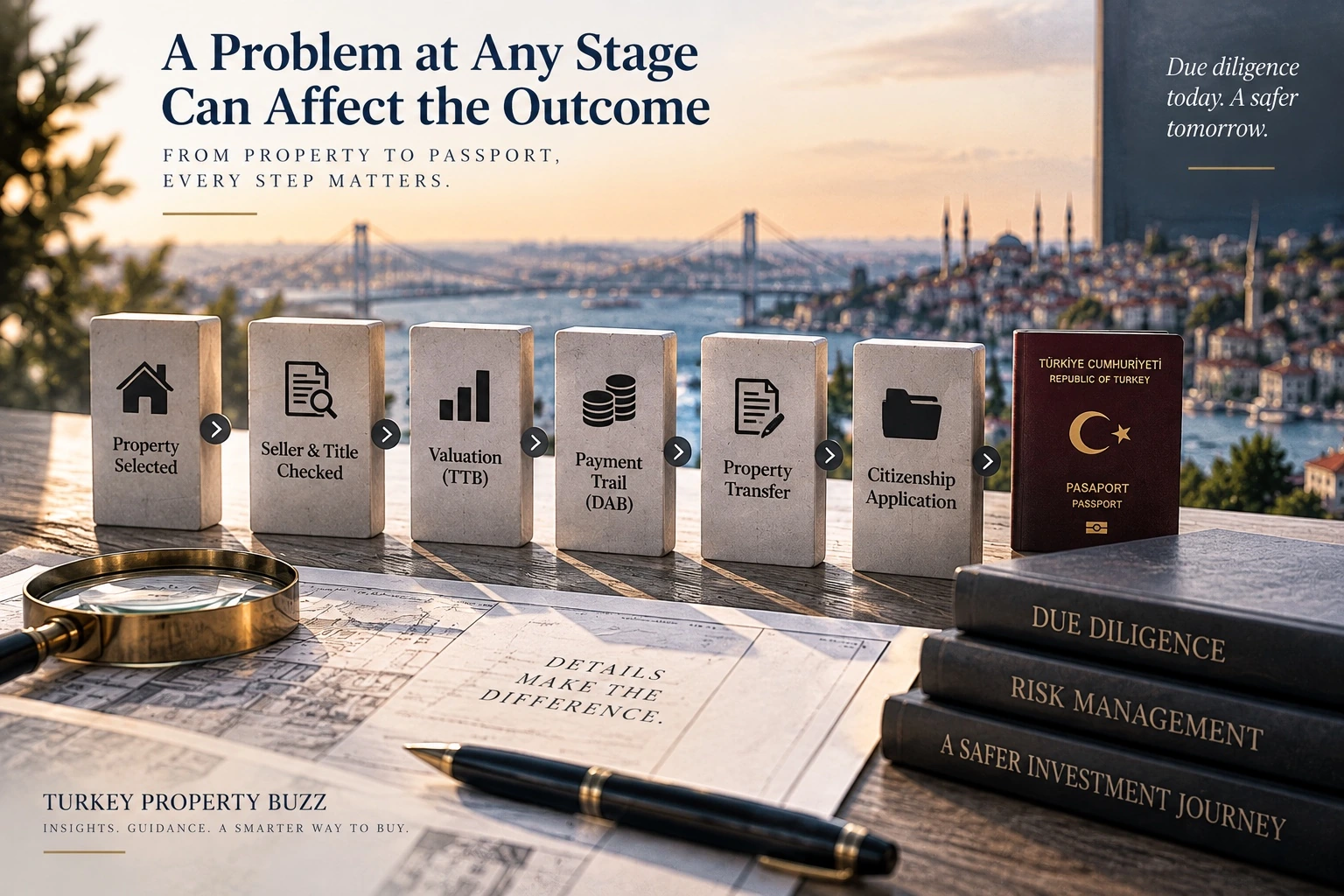
Before a buyer commits, the important questions are practical: Is this the exact unit being purchased? Who legally owns it? Has its history been checked? Does the valuation support the citizenship route? Is the real payment trail clear? Are the people advising the buyer independent enough to flag a problem rather than simply push the deal to closing?
You do not need to personally master every Turkish document or acronym. You do need a process in which the right professional is checking the right thing.
That is the heart of Turkish citizenship property due diligence: not collecting a thick folder of papers, but making sure the exact deal and the citizenship-related pieces have actually been checked.
For the wider property checks beyond citizenship, see our Property Due Diligence Guide.
Where buyers can get exposed
Problems often begin when speed and sales pressure replace verification.
Pause if you hear things like:
- “Citizenship is guaranteed.”
- “Pay the deposit today and we will sort the documents later.”
- “The valuation can be adjusted to whatever number we need.”
- “Do not worry about who receives the money — this is how everyone does it.”
- “You do not need your own lawyer.”
Or if the legal seller, unit, payment recipient or agreed price changes and nobody can clearly explain why.
None of these automatically proves fraud. But each is a reason to stop, ask questions and get an independent answer before the next payment.
A buyer should never feel embarrassed for slowing a transaction down when the consequence could involve hundreds of thousands of dollars, years of ownership and a citizenship application.
What good buyer-side help should actually do
This is the part that matters most.
A buyer does not just need someone who can show apartments. The buyer needs people around the transaction whose job is to protect the quality of the decision.
Turkey Property Buzz does not replace a Turkish lawyer, an official valuer, a bank or the government authorities. Those professionals have their own roles.
Our role is on the buyer’s side of the table: helping define the objective, compare districts and properties, challenge the sales story, surface questions before money is committed, coordinate the appropriate independent checks, and make it clear what is verified versus what still needs professional confirmation.
Our Property Intelligence is built around the same idea: start with buyer fit and evidence, not a wall of developer inventory.
That matters because a citizenship-linked property purchase is not one decision. It is several decisions happening at once:
- Is this the right property?
- Is the price sensible?
- Does the transaction fit the citizenship route?
- Have the legal and ownership checks been done?
- Does the valuation support the file?
- Does the payment trail make sense?
- What happens if one of those checks fails?
A strong process tries to answer those questions before the buyer is locked in.
If you are already comparing Istanbul properties for citizenship, you can share your budget, objective and timing through Discuss Your Property Plans. We can help you organise the property decision and identify the checks that still need to be completed before you move forward.
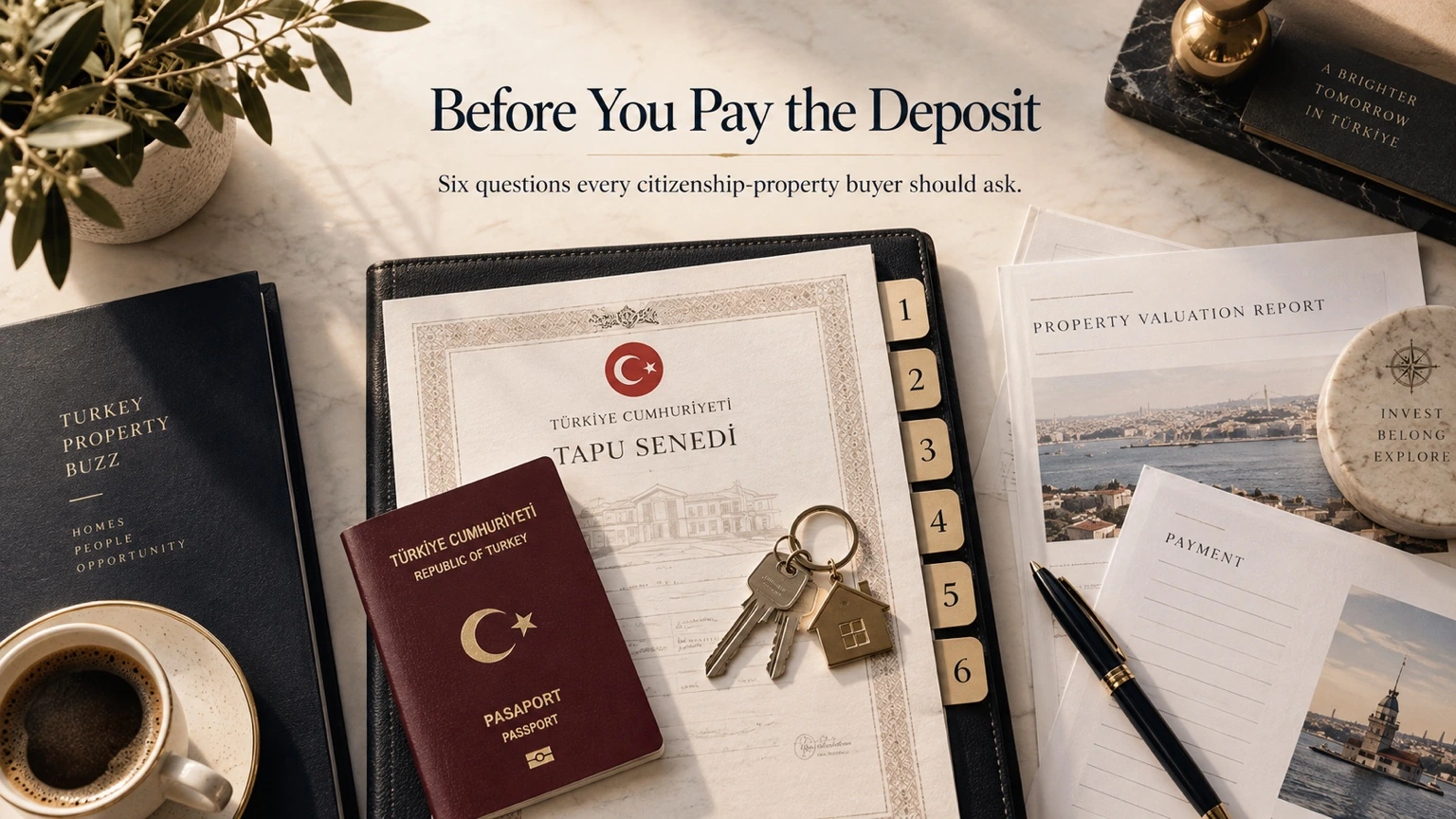
Before you pay a deposit, ask these six questions
1. Who owns the exact unit I am buying?
Do not rely on the project name alone. Make sure the unit, seller and authority to sell all line up.
2. Has the title and ownership history been checked for a citizenship-linked transaction?
The current seller’s name is only part of the story. The history of the property can matter.
3. Does the price and valuation make sense?
The sales price, the market value and the amount accepted for the citizenship process are not automatically the same thing. If something feels engineered simply to reach the threshold, stop and get it checked.
4. Is the money trail clear?
You should be able to understand who is paying, who is receiving the funds, what each payment is for and which records prove it.
5. What happens if an important check fails?
Before paying a non-refundable deposit, understand what happens if the unit, valuation, title history or citizenship-related checks do not work as expected.
6. Would I still buy this property without the citizenship pitch?
This is the question that brings the property decision back into focus.
A simple rule: clarity before commitment
There is no reason to turn a property purchase into a legal exam.
The buyer does not need to memorize every acronym. The buyer needs enough clarity to know what has been checked, who checked it and what is still unresolved.
That is also why we separate property advice from legal advice.
A property adviser can help you compare districts, projects, units, prices and buyer fit. A Turkish lawyer should handle legal review. The official valuation process deals with valuation requirements. Banks and government authorities handle their own parts of the transaction.
The danger is assuming one person is doing all of those jobs simply because they are coordinating the sale.
Frequently asked questions
Can Turkish citizenship be revoked or cancelled after it is granted?
Yes. Turkish law provides legal routes through which citizenship can later be annulled or withdrawn. The 2026 announcements are a reminder that a granted citizenship can still be reviewed in certain circumstances. That does not mean correctly completed property-based citizenship cases are automatically at risk.
Did 6,134 people lose Turkish citizenship because of property purchases?
No. The Interior Ministry’s 6,134 figure covered different categories and was not presented as a property-only total. Separately, the Justice Ministry announced citizenship-annulment proceedings involving 687 people in a property-related investigation.
What happened in the property-related investigation?
The Justice Ministry said the investigation involved allegations including false valuations, lower-value properties being presented at higher values, sham transactions and non-genuine money movements. Annulment proceedings were started for 687 people. Proceedings are not the same as a final decision in every case.
Is a developer or agent saying “citizenship eligible” enough?
No. Treat it as a marketing claim that still needs unit-specific and transaction-specific verification. The exact property, seller, title history, valuation, payment structure and buyer file matter.
Should I use an independent Turkish lawyer?
For a citizenship-linked purchase, yes. The lawyer’s role should be clearly defined, and the buyer should understand whether the lawyer is acting independently for them rather than simply facilitating the seller’s transaction.
What are DAB and TTB?
They are two different parts of the property-citizenship documentation process. In simple terms, DAB relates to the required foreign-currency conversion record, while TTB relates to the amount accepted from the valuation side for the citizenship process. You do not need to become an expert in either document; make sure the correct professionals confirm what is required for your specific transaction.
Can family members be affected if the main investor’s citizenship is annulled?
In some circumstances, yes. The treatment can depend on how the family members acquired citizenship and on the specific decision. That is a file-specific legal question.
Can I use more than one property to reach the citizenship investment amount?
Official guidance allows more than one property subject to the applicable conditions. The structure and timing should be checked before purchase rather than assumed after deposits have been paid.
Should I buy a property mainly because it helps with citizenship?
We do not recommend making citizenship the only reason a property makes sense. The unit should still fit your budget, location needs, ownership plan and eventual exit strategy.
The real lesson from the 2026 cases
The point is not that Turkish citizenship by investment is unsafe.
The point is that the quality of the underlying transaction matters.
A buyer can spend months searching, commit a large amount of capital, complete the property purchase and go through the citizenship process. If the original transaction was built on bad information, false documentation or a structure that should have been questioned, the consequences can arrive long after the sale is finished.
That is a terrible time to discover that something was wrong.
The better time is before the deposit. Before the transfer. Before the buyer becomes dependent on everyone else saying, “Do not worry.”
If you are considering Istanbul property — for citizenship, investment, family use or a future move — start with the property decision and build the citizenship route around verified facts.

Discuss Your Property Plans
Share your objective, budget and timing with Turkey Property Buzz. We will help you structure the property decision, identify suitable Istanbul options and clarify which professional checks still need to be completed before you commit.
If citizenship is part of your objective and you are still organizing the process, you can also Start Your Readiness Check.
Sources and methodology
The 6,134 figure comes from the Interior Ministry’s official announcement of 4 August 2026. It covers two distinct categories: citizenship decisions affecting 5,391 people were annulled following irregular or sham transactions, while decisions affecting 743 people were withdrawn on public-order or national-security grounds. Both figures include family members; 6,134 is not a property-fraud-only total. The Ministry said inspections involving the Tapu ve Kadastro Genel Müdürlüğü (TKGM), the Tax Inspection Board and the General Directorate of Security identified irregular or sham transactions. TKGM participated in those inspections; the Interior Ministry reported the overall figures.
The separate property-related investigation involving 687 people is supported by the Justice Ministry’s official announcement of 4 August 2026, with Independent Türkçe’s report from the same date as secondary corroboration. The 687 figure describes citizenship-annulment proceedings and must not be added to the Interior Ministry’s 6,134 total.
TPB gives official government statements priority, uses established news reporting for corroboration, and distinguishes government statements and investigation allegations from final legal findings. Ongoing proceedings are not final criminal judgments or confirmation that every citizenship cancellation has been completed. We have intentionally kept the legal explanation simple. The article is educational and does not determine whether any individual buyer, property or citizenship file is legally compliant.
Official sources:
- Interior Ministry — 6,134 people across two citizenship-action categories (4 August 2026)
- Justice Ministry — citizenship-annulment proceedings involving 687 people (4 August 2026; Turkish)
- Invest in Türkiye — property acquisition and citizenship
- Turkish Citizenship Law No. 5901
Secondary corroboration:
- Independent Türkçe — 16 ilde "vatandaşlık" operasyonu: 73 kişi gözaltına alındı (4 August 2026) — corroborates the separate 687-person proceedings.
Disclaimer
This article provides general property education, not individual legal, tax, banking, immigration or investment advice. Citizenship rules and administrative procedures can change. Obtain transaction-specific advice from qualified Turkish professionals and confirmation from the relevant authorities before committing funds.